
Case study · Events & ticketing
Wooziee: an event ticketing platform, built from scratch
A complete ticketing business — discovery, checkout, QR entry, organiser analytics and payouts — delivered across web, admin, Android and iOS, and launched in India and the UK.
01 Overview
One platform for organisers, staff and attendees
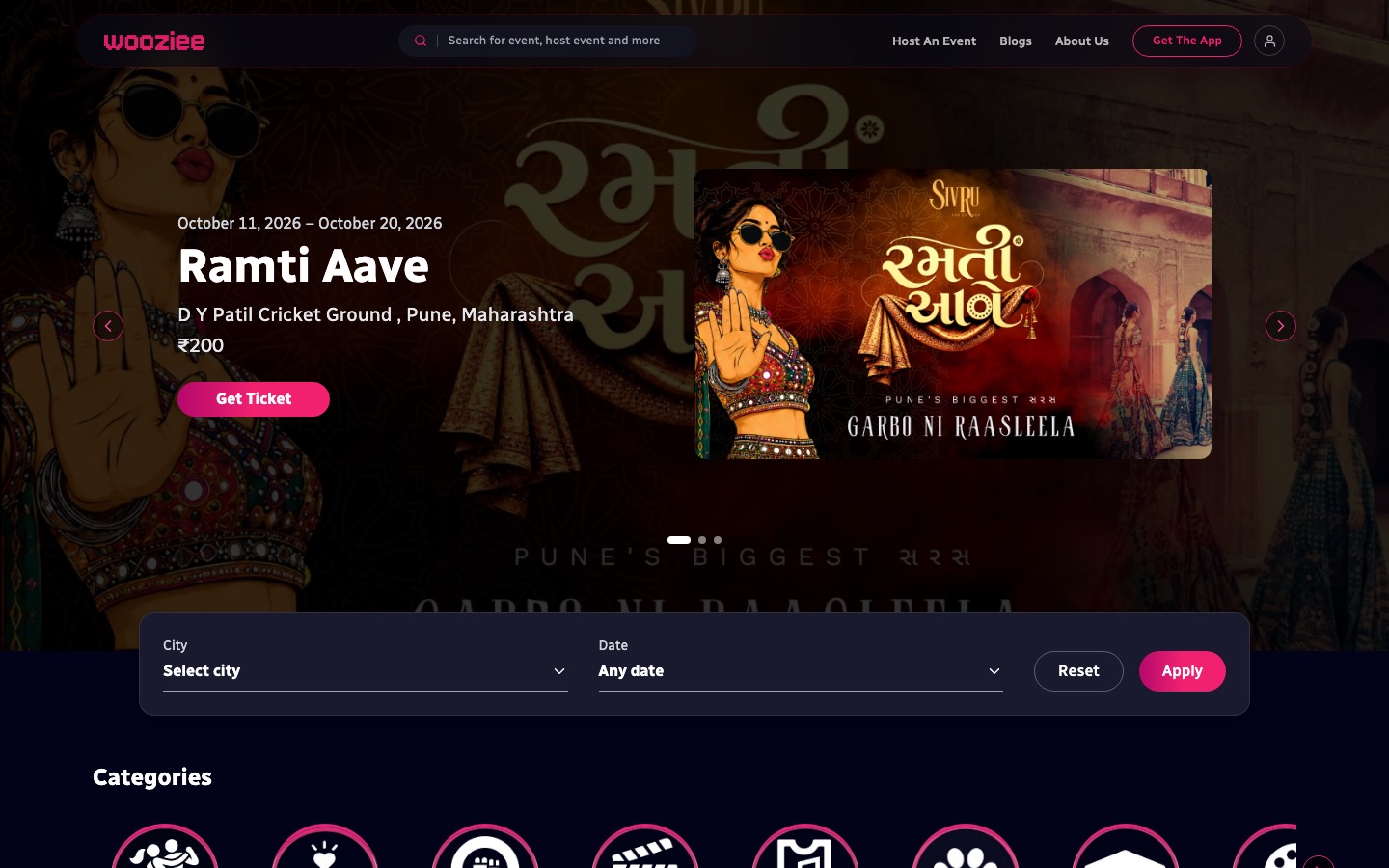
Wooziee needed to replace a patchwork of ticketing tools with a single product. Organisers create single or multi-day events, set ticket types with day-level pricing and inventory, run promoters and coupons, manage guestlists and receive payouts. Attendees discover events, pay, and carry QR tickets that gate staff scan at entry.
The platform serves four roles — platform admin, organiser admin, organiser staff and attendee — each with its own permissions, plus public, search-friendly event pages.
02 The challenge
Money, entry and trust all depend on getting the details right
- Payments that always reconcile. A paid order must become a valid ticket exactly once, even when callbacks arrive late or twice.
- Multi-day tickets. A ticket valid across several days must stay scannable on the remaining days while recording each entry.
- Granular organiser permissions. Organisations need custom staff roles, and access must respond to organisation status, not just user role.
- Discoverability. Event pages must be readable by search engines and AI assistants, not hidden behind a JavaScript-only app.
- Two markets. India and the UK need different payment providers, currencies and payout processes.
03 The solution
A modular platform with payments and entry designed in from day one
Ticketing & checkout
Multiple ticket types with day-level pricing and inventory, coupons, promoter referral links and ID-verified concession tiers.
Payments & payouts
Razorpay checkout with webhook-verified capture and Razorpay X payouts in India; Stripe checkout and webhooks in the UK edition.
QR entry & history
QR ticket PDFs, gate scanning from the organiser app and per-day entry history derived from scan records.
Organiser workspace
Analytics dashboards, conversion funnels, revenue breakdowns, guestlists and versioned organiser terms with recorded acceptance.
Real-time & notifications
Socket.IO for live order and scan events; queued email, push notifications and reminders.
Wallet & calendar
“Save to Google Wallet” ticket passes and “Add to Google Calendar” links for attendees.
04 Architecture & technologies
Architecture at a glance
05 Implementation approach
Decisions that kept the platform dependable
- Webhook-verified capture. Orders are confirmed only by verified payment-provider events, with reconciliation to catch mismatches.
- One permission catalogue. The API and the admin UI read the same catalogue, so permission screens can never drift from what the server enforces.
- Private document handling. ID uploads for concession tickets are stored privately, served through short-lived signed URLs, logged on every view and deleted after the event.
- Human-readable URLs. Events get SEO slugs while legacy ID URLs keep working.
- Automated quality gates. Playwright suites cover smoke tests, landing pages, SEO, accessibility, AI-crawler access, security regressions and API behaviour.
06 Results
Where Wooziee is today
Wooziee is live in production at wooziee.com, with a UK edition at wooziee.co.uk running on Stripe. Organisers run events end to end on the platform — from publishing to entry scanning and payouts — and the same API powers the web, admin and mobile apps.
We publish only verified outcomes. Business metrics such as ticket volumes are the client's to share.
Quick answers
Wooziee at a glance
What is Wooziee?
Wooziee is an event management and ticketing platform. Organisers create and promote events, sell tickets, manage guestlists, scan QR tickets at entry and receive payouts; attendees discover events, buy tickets and keep them on their phone.
What technology does Wooziee use?
A React 18 web app and admin console, Flutter apps for Android and iOS, and a Node.js (Express 5) API on MySQL 8 with Redis, Bull queues, Socket.IO, AWS S3 and CloudFront, Razorpay in India and Stripe in the UK, with Sentry and New Relic monitoring.
What was ImliStack's role on Wooziee?
Our founder led a team of five to build Wooziee from scratch — product architecture, back end, web and admin front ends, the Flutter apps, payments, infrastructure and testing — through to production launch.

Next step
Have a product to build or a system to fix?
Tell us what you are working on. You will get a considered reply from an engineer — with questions, a suggested approach or an honest “we are not the right fit”.